

Modifications vs. Accommodations - What’s the Difference?
If your child has an Individualized Education Program (IEP) or a 504 Plan, then it's highly likely that you’ve heard the terms “accommodations” and “modifications.” They sound quite similar, but they not only mean very different things, they also provide different support for your child at school. Understanding that difference is key to ensuring sure your child has the right support in place.
We need to be asking - what should schools be doing to support our struggling readers to make growth? The good news is that we now know what works and what doesn’t, thanks to years of research and the Science of Reading.

Reading Interventions That Are Evidence-Based (And What Isn’t)
Reading is a foundational skill that is centered at the core of academic success, and yet we see too often that even with the best intentions in mind, schools may still be relying on outdated or unproven methods and interventions that don’t actually help struggling readers. The difference between an evidence-based reading intervention and a well-intentioned, yet ineffective strategy, can make or break a child’s reading progress.
We need to be asking - what should schools be doing to support our struggling readers to make growth? The good news is that we now know what works and what doesn’t, thanks to years of research and the Science of Reading.

Communication and Special Factors on an IEP: What Parents Need to Know
One of the most important areas considered under the Special Factors section of an IEP is communication. How a child expresses themselves and understands others can significantly impact their ability to access learning, participate in class, and engage with peers. As an advocate, I work with families to make sure communication needs are fully addressed in their child’s IEP.

IDEA Anniversary (Nov 29, 1975): What’s Changed—and What Hasn’t
On November 29, 1975, the United States passed one of the most important civil rights laws for children with disabilities: the law that eventually became the Individuals with Disabilities Education Act, or IDEA. Before this law existed, more than a million children with disabilities were denied access to public school entirely, and millions more were placed in segregated or inadequate settings without support. The anniversary of IDEA is a reminder of how far we have come, and how far we still have to go.

The Hidden Power of Parent Input Statements in IEPs
Parent input statements are often overlooked, yet they are one of the most effective tools parents have in the IEP process. When written clearly and strategically, they strengthen your role on the team, organize your priorities, and create a documented record of your concerns and requests.

A Thanksgiving Message for Families Navigating Special Education
Thanksgiving often brings a mix of gratitude, reflection, family time, and if we’re being honest, a fair amount of stress. For families navigating IEPs, 504 Plans, behavior plans, school challenges, or ongoing challenges, the holiday season can feel complicated. There’s gratitude for progress, frustration with setbacks, and constant concern about what comes next.
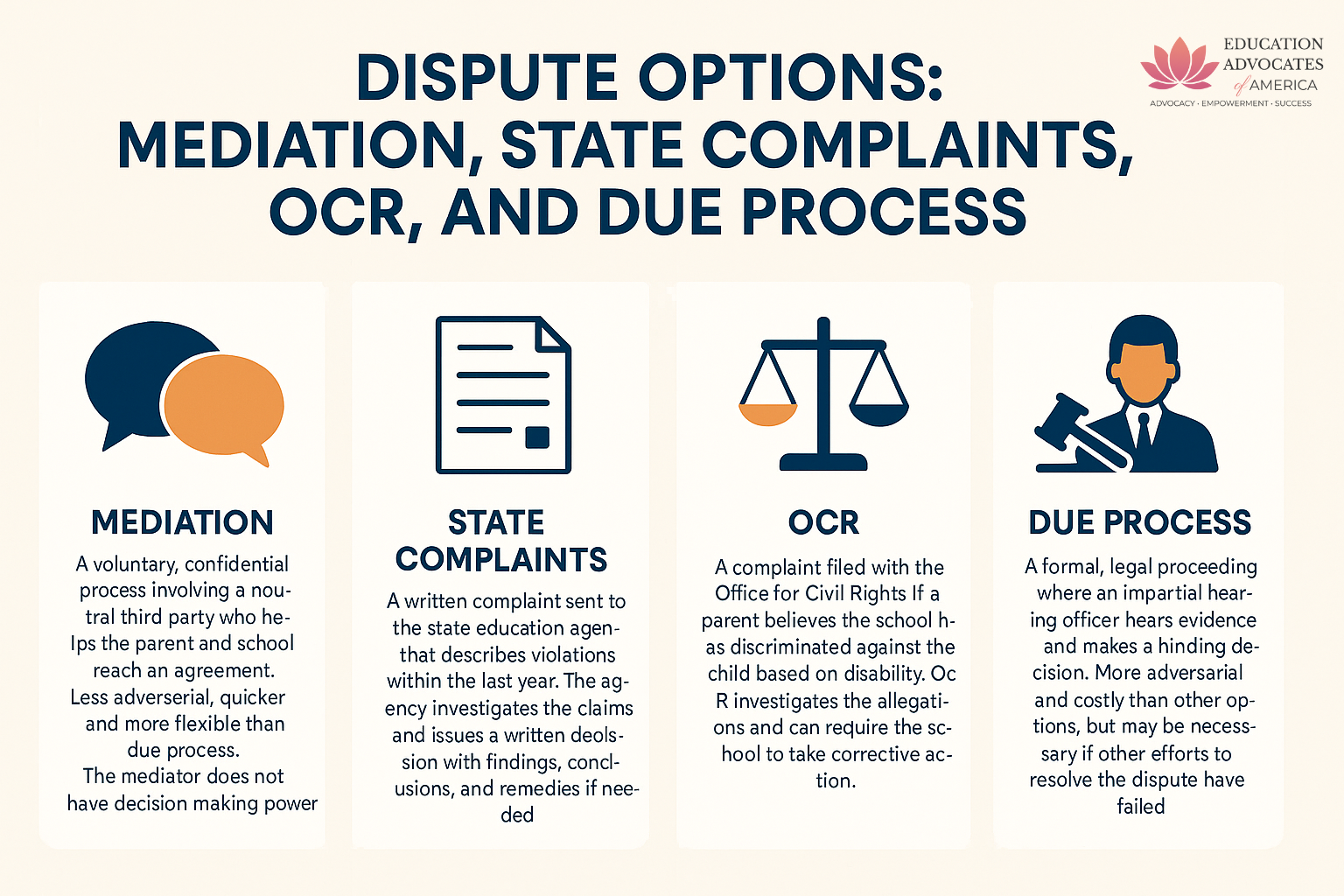
Dispute Options: Mediation, State Complaints, OCR, and Due Process Understanding Your Choices When You and the School Disagree
When a school is not following a child’s IEP, refuses to evaluate, denies services, or simply will not work collaboratively, families often feel stuck. The good news is that IDEA, Section 504, and federal civil rights laws give parents several options to resolve disputes. Each option serves a different purpose, and knowing which one to use can save time, stress, and ensure your child gets the support they need.
When Schools Deny Your Request for an Evaluation Based on "Good Grades”
If you’ve ever approached your child’s school and made a request for a comprehensive psychoeducational evaluation only to hear a statement along the lines of “We can’t/won’t evaluate because your child has good grades,” or “We don’t feel they will qualify or need the support because they have good grades” then you’re not alone and you certainly aren’t without options.
IEP service minutes reflect the school’s legal obligation to provide specialized instruction and support. If they’re wrong or incomplete, then your child may not receive the help they’re entitled to or that they require. Here’s a clear, step-by-step guide for parents on how to handle missing or inaccurate minutes in their child’s IEP.

Understanding Assistive Technology: Empowering Students Through the Right Tools
As an advocate, one of the most powerful ways I support families is through assistive technology (AT). Assistive technology includes any device, software, or equipment that helps a student work around challenges so they can access their education and fully demonstrate their abilities.

How to Prepare for an IEP Meeting in 30 Minutes
IEP meetings move quickly, and preparation matters even when time is limited. With a focused plan, you can walk in ready to participate effectively and clearly.

Handling Missing or Inaccurate IEP Minutes
For many parents, after you leave your child’s IEP meeting with the school and you receive a finalized copy of their IEP, you may assume that everything that was discussed together as a team (Parents, YOU are a part of that team!) was recorded accurately and will be implemented as discussed. This includes all service minutes. A question we often get is: What do I do if I notice that something that was discussed in the meeting is now missing, inaccurate, or doesn’t match the verbal conversation we had during the IEP meeting?
IEP service minutes reflect the school’s legal obligation to provide specialized instruction and support. If they’re wrong or incomplete, then your child may not receive the help they’re entitled to or that they require. Here’s a clear, step-by-step guide for parents on how to handle missing or inaccurate minutes in their child’s IEP.

What a Good Functional Behavior Assessment Includes
A Functional Behavior Assessment is a formal process used in schools to understand why a student is engaging in challenging behavior in order to guide prevention and intervention efforts, thus increasing efficiency and effectiveness. The goal of an FBA is to identify what the behavior looks like, when and where it occurs, what happens afterward, and identify what the student is trying to communicate or achieve through their behavior.

When Schools Call You to Pick Up Your Child
Many parents experience the same scenario: the school calls and says your child is dysregulated, unsafe, or “having a hard day,” and asks you to pick them up early. But when you arrive, you learn your child has not been suspended. These informal removals, sometimes called soft suspensions, parent pick ups, early dismissals, or “cool off days,” are still removals under federal law, even if the school does not document them.

What Every Parent Should Know Before Their First IEP Meeting
Your first IEP meeting can feel overwhelming. You want to make sure your child gets the right support, but the process is full of unfamiliar terms, professionals, and paperwork. The good news? You don’t have to go in unprepared. Understanding what to expect and what your role is can make all the difference.
Here’s what every parent should know before sitting down at that first IEP table.

When the School Says There’s No Staff
Parents hear it all the time when requesting services, evaluations, related service minutes, or behavior support: “We don’t have the staff.” Schools may be short on special education teachers, paraprofessionals, therapists, or behavioral specialists, but legally, lack of staffing is not a valid reason to deny or delay services. Under federal law, schools must provide what a child needs in order to receive a Free Appropriate Public Education (FAPE), even if they are understaffed or financially strained.

When the Mask Comes Off: Supporting Kids Who Fall Apart After School
If you have ever greeted your child after school with a smile and a snack, only to be met with tears, anger, or total shutdown, you are not alone. Many families of children with IEPs or 504 Plans experience this every afternoon. As an advocate, educator, and mom, I have seen it from all sides, including at home with my own kids. It can feel confusing and frustrating when your child seems to hold it together all day for their teachers, only to unravel the minute they walk through the door. But this pattern is not defiance or bad behavior... It is a sign of exhaustion.

Parent–School Communication: Email Scripts for Common Scenarios
As a former administrator and teacher and currently parent advocate, I’ve learned that clear and respectful communication can change everything when it comes to supporting a child’s needs at school. Many families want to do the right thing but feel unsure of what to say or how to ask for it. Having a few sample emails can make that process much easier and take the stress out of writing from scratch. Use these with confidence and know that we are here to support you for any questions or concerns you have beyond this!
Below are some practical email examples for common IEP and 504 situations. You can copy and personalize them depending on your child’s needs.

Quick Guide: Special Factors on an IEP
What Are Special Factors?
The Special Factors section of an IEP is a critical, yet often overlooked, part of your child’s plan. This is where the IEP team considers areas that may significantly impact your child’s ability to access learning, participate fully in school, and make progress toward their goals. Addressing these factors ensures that the IEP is truly individualized and tailored to your child’s unique needs.

Preparing for Holiday Disruptions: Supporting Your Child During a Winter Break
The holiday season is full of excitement, family gatherings, travel, and changes to daily routines. For children with IEPs or 504 plans, these changes can be both super fun and extremely challenging. Even short breaks from school can affect learning, behavior, and emotional regulation. With a little planning, you can help your child stay on track while still enjoying the holidays.

When Your Child Needs a 1:1 Aide How to Justify It
When your child needs individualized support throughout the school day, it’s important to know how to advocate effectively and describe the need in a way that aligns with the language schools use. Instead of asking for a “1:1 aide,” which districts sometimes resist because it implies a dedicated staff person assigned only to one student, it is often better to frame the need as requiring “adult support all day.” This focuses the conversation on your child’s functional and safety needs rather than the staffing structure.